
Some days feel too heavy to carry alone. You wake up tired, worried, or sad, and you wish someone would say the right words. God’s Word can be that voice. This guide shares sixteen Bible verses for encouragement, grouped by what you face: fear, weariness, discouragement, worry, grief, an unclear future, and weakness.
Each verse includes its exact text, its history, what it means today, and a simple way to live it out. You will also find related Scriptures, a short prayer, and answers to common questions. Read slowly. Let one verse settle in your heart, and let hope grow from there.
What Are the best bible verses for Encouragement?
The best Bible verses for encouragement are Isaiah 41:10, Joshua 1:9, psalm 46:1, Matthew 11:28, and Philippians 4:6-7. Each one speaks to a common struggle, such as fear, tiredness, or worry. Together they show one steady message: God is near, God is strong, and God cares about you.
| If you feel… | Turn to | The big idea |
|---|---|---|
| Afraid | Isaiah 41:10 | God gives you strength for what scares you |
| Worn out | Matthew 11:28 | Jesus offers rest to tired people |
| Sad and low | Psalm 42:11 | Hope can answer a heavy heart |
| Worried | Philippians 4:6-7 | Prayer brings a peace that protects |
| Heartbroken | Psalm 34:18 | The Lord stays close in sorrow |
| Unsure of the future | Jeremiah 29:11 | God still has good plans in a long wait |
| Weak | 2 Corinthians 12:9 | Christ’s power fills our gaps |
| Forgotten | Lamentations 3:22-23 | Kindness arrives fresh each morning |
[link to related verse/topic on blessingsvault.com: Bible verses for hope]
Encouraging Bible Verses When You Feel Afraid
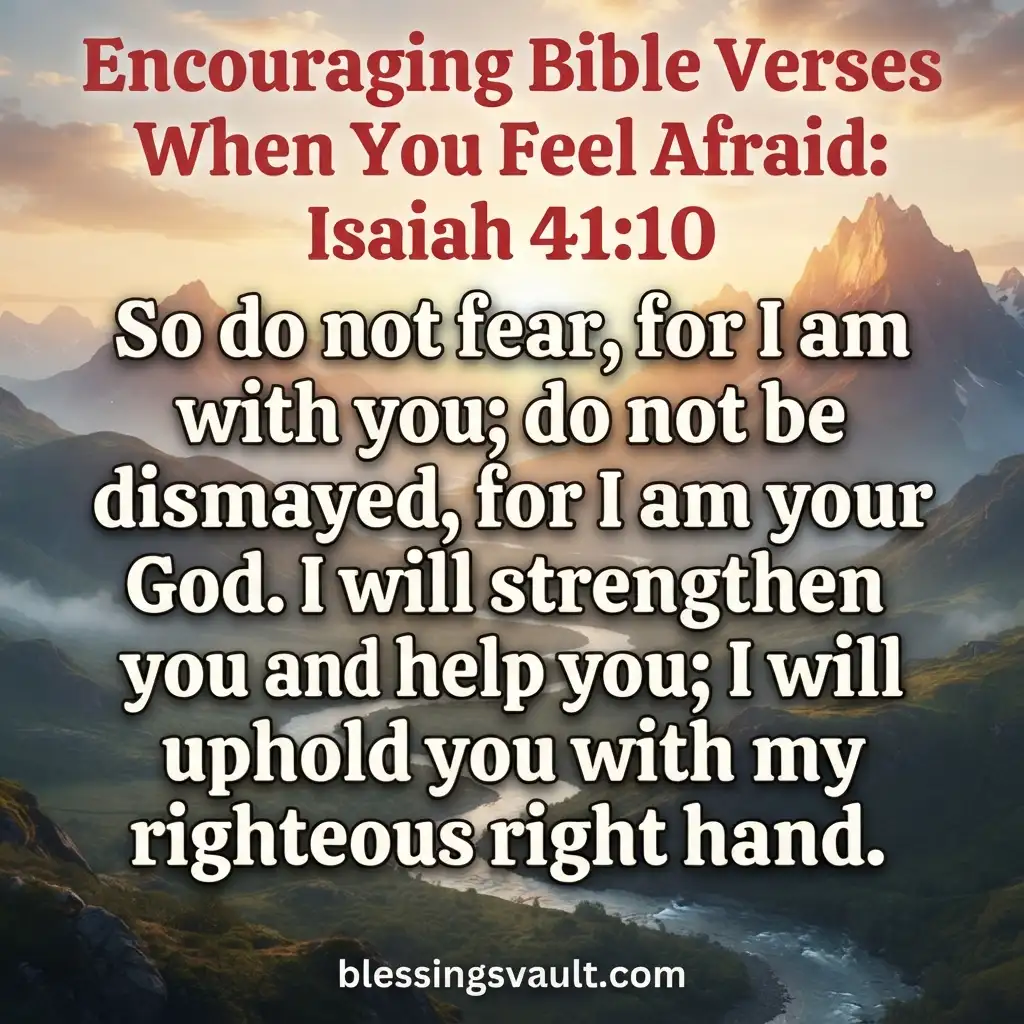
Isaiah 41:10, Joshua 1:9, and Psalm 46:1 are strong verses for a fearful heart. In each, God speaks or is described as close, strong, and ready to help. Fear may show up, but these verses teach that it does not have to take charge.
Isaiah 41:10 (NIV): God Holds You Up
“So do not fear, for I am with you; do not be dismayed, for I am your God. I will strengthen you and help you; I will uphold you with my righteous right hand.”
What it meant then. The prophet Isaiah lived in the 700s BC. In this part of his book, God comforts a people who feel small and scared. Strong nations surrounded them, and exile was a real danger. God answers with four promises: I am with you, I will strengthen you, I will help you, and I will uphold you. The “right hand” stood for power and safekeeping.
Why it matters today. Fear still comes through bills, test results, and bad news. This verse offers something firmer than “don’t worry.” It offers a Person who stays.
How to live it out. Say the verse aloud, one promise per breath, the next time your heart races. You could also tape it inside your work bag.
Related verses. Isaiah 43:1-2 (God calls you by name and walks through water and fire with you), Psalm 56:3 (trust replaces fear), and Psalm 118:6 (fear loses power when the Lord is on your side).
Joshua 1:9 (NIV): Courage for the Next Step
“Have I not commanded you? Be strong and courageous. Do not be afraid; do not be discouraged, for the Lord your God will be with you wherever you go.”
What it meant then. Moses had died, and Joshua now had to lead Israel into the land God had promised, over three thousand years ago. Walled cities and strong armies waited ahead. God did not tell Joshua to feel brave. He told him to act with courage, because help would travel with him.
Why it matters today. Courage is not the absence of fear. It is a step taken while your knees still shake. That truth frees you to move before you feel ready.
How to live it out. Name one scary task you have been avoiding. Take the first small action today, like sending the email or making the call.
Related verses. Deuteronomy 31:6 (Moses gave Israel the same charge), 1 Chronicles 28:20 (David said it to Solomon), and 2 Timothy 1:7 (God gives power, love, and self-discipline instead of timidity).
Psalm 46:1 (NIV): A Safe Place in Trouble
“God is our refuge and strength, an ever-present help in trouble.”
What it meant then. This psalm also comes from the sons of Korah, a family of temple singers. The verses that follow describe shaking mountains and roaring seas. Ancient cities counted on thick walls and high towers to stay safe. The writer says God is that safe place.
Why it matters today. Trouble never sends a notice first. This verse says help is “ever-present,” so you never have to go searching for it.
How to live it out. When bad news hits, pause before panic takes over and pray one sentence: “Lord, I’m running to you.”
Related verses. Psalm 91:1-2 (a shelter for those who rest in God), Proverbs 18:10 (the Lord’s name is a strong tower), and Nahum 1:7 (the Lord is good, a refuge in times of trouble).
[link to related verse/topic on blessingsvault.com: Bible verses about fear and courage]
Bible Verses for Encouragement When You Feel Tired
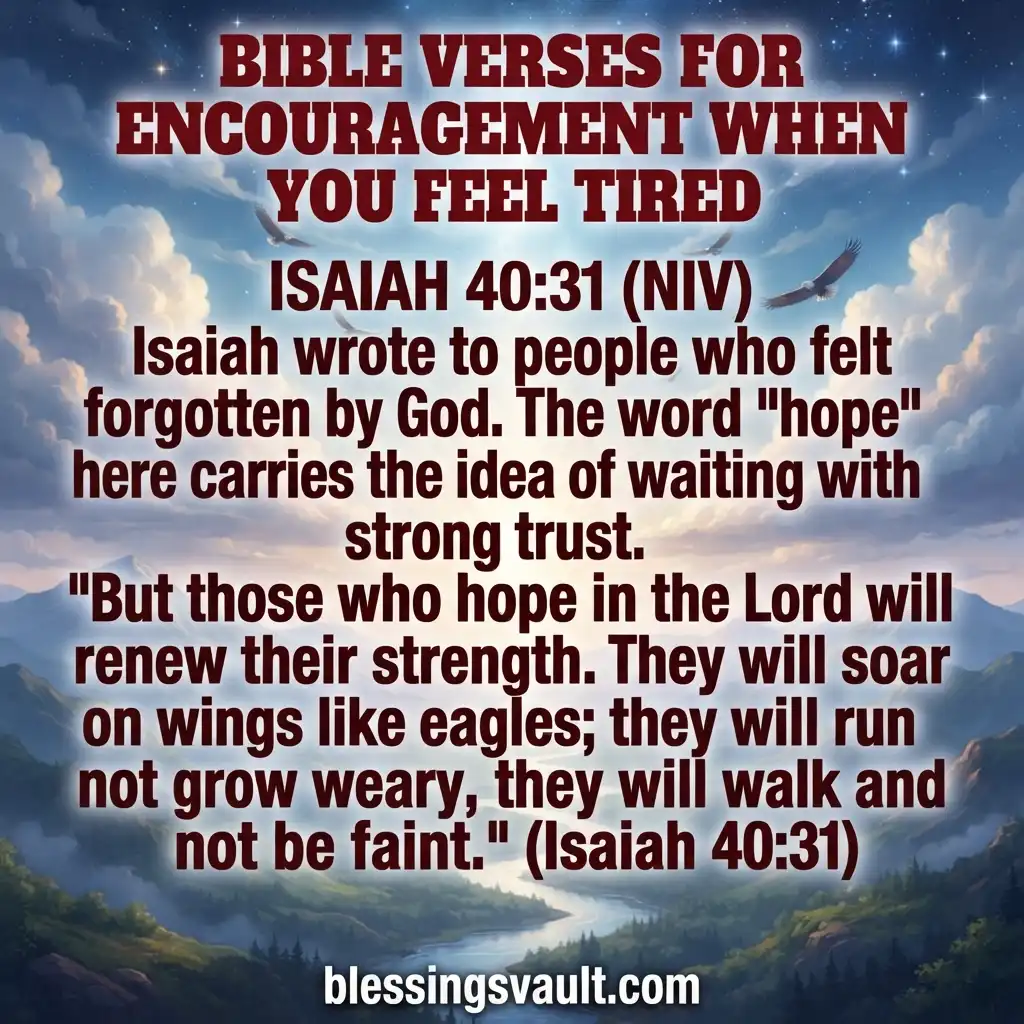
Matthew 11:28 and Isaiah 40:31 speak best to a tired soul. Jesus invites weary people to come to him for rest. Isaiah says those who hope in the Lord get fresh strength. Both Bible verses for encouragement treat tiredness as something God cares about, not something to hide.
Matthew 11:28 (NIV): Rest for the Weary
“Come to me, all you who are weary and burdened, and I will give you rest.”
What it meant then. Matthew, a former tax collector, recorded these words. Jesus spoke to crowds living under Roman rule. Many worked hard just to feed their families, and many felt crushed by strict religious rules. Right after this verse, Jesus mentions a yoke, a wooden frame that joined two animals. He offers to share the load.
Why it matters today. Busy phones and long to-do lists wear us out too. Jesus does not ask us to earn rest. He invites us to receive it.
How to live it out. Set aside ten quiet minutes tonight. Leave your phone in another room, list what drains you, and hand each item over in prayer.
Related verses. Psalm 62:1 (rest for the soul is found in God alone), Exodus 33:14 (God promises his presence and rest), and Hebrews 4:9-11 (a Sabbath rest remains for God’s people).
Isaiah 40:31 (NIV): Strength Like an Eagle
“But those who hope in the Lord will renew their strength. They will soar on wings like eagles; they will run and not grow weary, they will walk and not be faint.”
What it meant then. Isaiah wrote to people who felt forgotten by God. The word “hope” here carries the idea of waiting with strong trust. The eagle picture is chosen with care: eagles glide on rising air instead of flapping nonstop. Strength comes from leaning on God’s power.
Why it matters today. Burnout is common now. This verse says rest and trust are part of God’s plan, not signs of weakness.
How to live it out. Choose one task you can set down this week. Ask God for the wisdom to let it go.
Related verses. Psalm 27:14 (wait for the Lord and take heart), Exodus 19:4 (God carried Israel on eagles’ wings), and Galatians 6:9 (do not grow weary in doing good).
Uplifting Scripture for a Discouraged Heart
Psalm 42:11 is one of the best verses for a discouraged heart. The writer talks to his own sad soul and tells it to hope in God. Lamentations 3:22-23 adds a second gift: fresh mercy every morning. Both show that low days can still hold real hope.
Psalm 42:11 (NIV): Talk to Your Own Soul
“Why, my soul, are you downcast? Why so disturbed within me? Put your hope in God, for I will yet praise him, my Savior and my God.”
What it meant then. The writer felt far from the temple in Jerusalem, where he loved to worship, and tears had been his food. Then he began to talk to his own soul. The same line shows up in Psalm 42:5 and Psalm 43:5, so sad feelings visit more than once.
Why it matters today. Many of us listen to our worst thoughts all day long. This psalm teaches us to answer back with truth.
How to live it out. Write down three heavy thoughts. Beside each one, write “Put your hope in God” and one reason to hope.
Related verses. Psalm 43:5 (the refrain returns), Psalm 62:5 (the soul finds rest in God), and Romans 15:13 (the God of hope fills you with joy and peace).
Lamentations 3:22-23 (NIV): Mercy That Starts Fresh
“Because of the Lord’s great love we are not consumed, for his compassions never fail. They are new every morning; great is your faithfulness.”
What it meant then. Enemies burned Jerusalem in 586 BC, and tradition says the prophet Jeremiah wrote this poem of sorrow. In the middle of deep grief, the writer remembers God’s steady love. God’s kindness does not run out overnight.
Why it matters today. A rough yesterday does not decide today. Every sunrise comes with a new supply of mercy.
How to live it out. Before you look at your phone tomorrow morning, whisper the words “new every morning” and thank God for one small gift.
Related verses. Psalm 30:5 (joy comes in the morning), Psalm 90:14 (God satisfies us in the morning with his love), and Psalm 143:8 (let the morning bring word of his unfailing love).
Bible Verses to Calm Worry
Philippians 4:6-7 and 1 Peter 5:7 are the top Bible verses for worry. They say to bring every concern to God in prayer and to hand him your anxious thoughts. In return, God offers a peace that guards your heart and mind, even when nothing around you has changed yet.
Philippians 4:6-7 (NIV): Peace That Guards
“Do not be anxious about anything, but in every situation, by prayer and petition, with thanksgiving, present your requests to God. And the peace of God, which transcends all understanding, will guard your hearts and your minds in Christ Jesus.”
What it meant then. Paul wrote to friends in the Roman city of Philippi, most likely from prison in the early 60s AD. He had plenty of reasons to worry, yet he showed them how to pray. His plan has three parts: pray, give thanks, and be specific. The promised peace “transcends all understanding,” which means it makes no sense on paper.
Why it matters today. Worry loves to replay the same thoughts. Prayer breaks the loop by giving those thoughts somewhere to go.
How to live it out. Write your worries on the left side of a page and three thank-yous on the right. Then pray over the whole page.
Related verses. Matthew 6:25-34 (Jesus points to birds and flowers), Psalm 94:19 (God’s comfort brings joy when anxiety is great), and John 14:27 (Jesus leaves his peace with us).
1 Peter 5:7 (NIV): A Caring God
“Cast all your anxiety on him because he cares for you.”
What it meant then. The apostle Peter wrote to believers scattered across what is now Turkey, many of whom were treated unfairly for their faith. The word “cast” means to throw. He says to toss all your anxiety, not only the small parts, and he gives the reason at the end: he cares.
Why it matters today. Caring is what turns this from advice into comfort. You aren’t handing your worries to a machine. You are handing them to someone who loves you.
How to live it out. Picture each worry as a stone. Drop it into deep water and say, “Lord, you take this one.”
Related verses. Psalm 55:22 (he will sustain you), Psalm 68:19 (God daily carries our burdens), and Luke 12:22-26 (worry cannot add a single hour to life).
[link to related verse/topic on blessingsvault.com: Bible verses for anxiety and peace]
Comforting Bible Verses for Grief
Psalm 34:18 is a leading Bible verse for encouragement in grief. It says the Lord is close to the brokenhearted. Psalm 23:4 adds comfort: God walks with us through the darkest valley, not around it. Grief is not a lack of faith, and God welcomes tears.
Psalm 34:18 (NIV): Close to the Brokenhearted
“The Lord is close to the brokenhearted and saves those who are crushed in spirit.”
What it meant then. David wrote this psalm, and its heading ties it to a frightening time when he had to run for his life. The verse does not say God hurries pain away. It says God comes close. “Crushed in spirit” describes a person flattened by loss.
Why it matters today. Our world rushes people through grief. This verse permits you to hurt while knowing you are not alone.
How to live it out. Give yourself time and room to cry. Then call one trusted friend and let them sit with you. Tell God, in plain words, “I’m hurting.”
Related verses. Psalm 147:3 (he heals the brokenhearted), Psalm 56:8 (God keeps track of your tears), John 11:35 (Jesus wept), and Romans 12:15 (mourn with those who mourn).
Psalm 23:4 (NIV): Through the Darkest Valley
“Even though I walk through the darkest valley, I will fear no evil, for you are with me; your rod and your staff, they comfort me.”
What it meant then. David worked as a shepherd before he became king, so he knew a shepherd’s gear. The rod fought off wild animals. The staff guided and rescued sheep. Older Bibles say “the valley of the shadow of death.” The key word is “through.” A valley is a place you cross, not a place you stay.
Why it matters today. That is why families read this psalm at funerals and hospital bedsides. It meets the darkest hours with a promise of company.
How to live it out. Memorize the verse. Repeat it when you feel alone in a waiting room or a long night.
Related verses. Isaiah 43:2 (God is with you in the waters), John 10:11 (Jesus is the good shepherd), and Revelation 21:4 (God will wipe away every tear).
Scriptures About Hope and an Uncertain Future
Jeremiah 29:11 and Romans 8:28 speak best to an uncertain future. They do not promise an easy road. They promise that God has a purpose, stays at work in hard things, and can bring good out of them for people who trust him.
Jeremiah 29:11 (NIV): Good Plans in a Long Wait
“For I know the plans I have for you,” declares the Lord, “plans to prosper you and not to harm you, plans to give you hope and a future.”
What it meant then. This verse is famous and often misread. Jeremiah wrote it in a letter to Jewish people carried off to Babylon in 597 BC. The letter said their stay would last seventy years. It also told them to build houses, plant gardens, and pray for the city. So this is not a quick-fix promise.
Why it matters today. Many of us wait for a job, a diagnosis, or a change we cannot rush. This verse says God still has good plans for his people inside a long wait.
How to live it out. Ask what you can “plant” right where you stand: a habit, a friendship, or a way to serve. Grow while you wait.
Related verses. Jeremiah 29:12-13 (call on me and seek me with all your heart), Proverbs 3:5-6 (trust the Lord, and he makes your paths straight), and Ephesians 3:20 (God can do more than we ask or imagine).
Romans 8:28 (NIV): Good Woven Into Hard Things
“And we know that in all things God works for the good of those who love him, who have been called according to his purpose.”
What it meant then. Paul wrote to the church in Rome around AD 57. Many people read this verse to mean that everything that happens is good. It does not say that. Bad things are still bad. Paul says God works within them, and the next verse names the goal: to shape us to be like Jesus.
Why it matters today. This verse offers meaning without pretending the pain is fine. Your hard chapter is not wasted.
How to live it out. Think of a past struggle. Write down one thing it taught you about patience, trust, or love, and thank God for it.
Related verses. Genesis 50:20 (Joseph says what others meant for harm, God meant for good), Romans 8:29 (the goal of becoming like Jesus), and James 1:2-4 (trials build endurance).
Bible Verses for Strength When You Feel Weak
Philippians 4:13 and 2 Corinthians 12:9 are the best Bible verses about strength from God. Paul wrote both while facing hardship. He learned that Christ gives power to endure, and that God’s help shows up most clearly when we feel weakest.
Philippians 4:13 (NIV): Strength to Keep Going
“I can do all this through him who gives me strength.”
What it meant then. Paul wrote this from prison. Just before it, he says he had learned to be content with a full stomach or an empty one. So “all this” means facing both plenty and need. The verse is not a promise that every goal will work out. It promises strength to endure.
Why it matters today. This verse often appears on sports gear as a promise of victory. Its deeper power shows up on days when you must keep going and cannot win.
How to live it out. Save it for tasks that feel too big. Say it before a hard conversation, a long shift, or a tough test.
Related verses. Philippians 4:11-12 (the secret of being content), John 15:5 (apart from Jesus we can do nothing), and Isaiah 40:29 (God gives strength to the weary).
2 Corinthians 12:9 (NIV): Power in Weakness
“But he said to me, ‘My grace is sufficient for you, for my power is made perfect in weakness.'”
What it meant then. Paul had a painful problem he called a “thorn in the flesh,” and he never says what it was. Three times he begged God to take it away. God said no and offered grace instead. Weakness became the place where Christ’s power showed up.
Why it matters today. We are told to look strong all the time. This verse frees us to be honest about our limits.
How to live it out. Say, “I can’t handle this alone,” out loud. Then ask a friend for help and ask God for grace.
Related verses: 2 Corinthians 12:10 (Paul is content in weakness for Christ’s sake), Psalm 73:26 (God is the strength of my heart), and Psalm 28:7 (the Lord is my strength and shield).
Bible Verses to Encourage a Friend
To encourage a friend, share 1 Thessalonians 5:11 with one kind sentence of your own. Keep the message short and warm. A personal note shows you care, and the verse adds hope that lasts beyond the moment. Sending it on a normal day, not only a hard one, makes it mean even more.
1 Thessalonians 5:11 (NIV): Build One Another Up
“Therefore encourage one another and build each other up, just as in fact you are doing.”
What it meant then. Paul wrote to a new church in Thessalonica, in one of his earliest letters, around AD 50. The believers faced pressure from their neighbors. He told them to keep lifting each other. Notice his last phrase, “just as in fact you are doing.” He praised what he already saw.
Why it matters today. Many people feel unseen. A short, kind note can be the only light someone gets that week.
How to live it out. Send a text today with this verse and one sentence about a strength you see in your friend.
Related verses. Proverbs 12:25 (a kind word cheers a heavy heart), Galatians 6:2 (carry each other’s burdens), and Hebrews 10:24-25 (spur one another on toward love and good deeds).
[link to related verse/topic on blessingsvault.com: how to encourage others with Scripture]
How to Use Encouraging Bible Verses Every Day
The best way to use encouraging Bible verses for encouragement is to read one slowly, look at the chapter around it, and pray it back to God with your own voice. Then keep it close by writing it down or memorizing it. Small daily habits help a verse stay with you.
Pick one verse that fits your day, using the table above.
Read the chapter around it so you know who spoke and why.
Copy it by hand in a notebook or on a sticky note.
Place it where you’ll see it, like a mirror or your phone’s lock screen.
Pass it on to someone who needs a lift.
[link to related verse/topic on blessingsvault.com: how to memorize Scripture]
Frequently Asked Questions
What is the most encouraging Bible verse?
No single verse stands out, but Romans 8:38-39 is a favorite among many believers. It says that nothing in all creation can separate us from God’s love. Isaiah 41:10 and Psalm 46:1 are also popular picks. The best verse is the one that meets your need today.
What should I read in the Bible when I feel down?
Open the book of Psalms and read one chapter slowly. The Psalms give words to feelings you may not be able to name. Psalm 121 is a calm place to begin, since it says our help comes from the Lord, who made heaven and earth.
Is it wrong to feel discouraged as a Christian?
No. Faithful people in the Bible felt low too. The prophet Elijah grew so worn out that he wanted to give up on life (1 Kings 19), and God answered with sleep, food, and a gentle voice instead of a scolding.
Do these verses apply to me, or only to the people who first heard them?
Some promises were first made to a certain person or group, so background matters. Jeremiah 29:11 is a good example. Even so, these verses reveal God’s steady character, which helps all believers. Ask what a verse teaches about who God is, then apply it with care.
What does the Bible say about encouraging others?
The Bible calls believers to lift each other up often. Hebrews 10:24-25 urges us to spur one another toward love and good deeds. Meeting regularly, such as at church or in a small group, makes that easier.
What if Bible verses do not seem to help my sadness?
Some seasons of sadness need more than a verse, and that is okay. Keep reading Scripture, and also talk with a pastor, counselor, or doctor. If you ever think about harming yourself, contact your local emergency number or a crisis line right away. Asking for help is wise, not a sign of weak faith.
Conclusion
These sixteen verses walk through fear, tiredness, sadness, worry, grief, an uncertain future, weakness, and friendship. In every one, the same steady truth shines: God is near, and he is strong enough to help. You do not have to feel better before you turn to him. Choose one verse and let it walk with you today. Which one speaks to you most?
Father, thank you for words that lift us. Help me hold on to one of these promises today. Give me courage for what scares me, rest for what tires me, and peace for what worries me. In Jesus’ name, amen.

Hi, I’m James Walker , the creator of Blessings Vault. I write meaningful blessings, wishes, and inspirational messages to help people find the right words for every moment. My goal is to create content that is simple, heartfelt, and truly helpful for readers.