
Have you ever stopped to look at one small flower and felt your worries ease? Many of us have. God made flowers to lift our eyes. That is why the Bible mentions them again and again. These Bible verses about flowers show His care, His love of beauty, and His power to renew what looks dead.
Some verses are gentle. Some are sobering. All of them point you back to Him. Below, you will find 23 verses from the King James Version, each with a simple meaning and a way to live it today. Read slowly. Let each blossom speak to your heart.
What Does the Bible Say About Flowers?
The Bible uses flowers in three main ways. First, they show God’s care. Jesus said God dresses the wild flowers, so you can trust His care. Second, they show how short life is. People fade like blossoms, but God’s word lasts forever. Third, they point to beauty, love, and new life.
In ancient Israel, wild flowers bloomed after the winter rains. Then a hot desert wind dried them out within days. Everyone saw this every year, so the Bible’s writers used flowers to show how fast life passes. Families did not keep cut flowers in vases as we do today. Dry grass and wild plants were burned as fuel in clay ovens.
Here are a few key words behind these scriptures about flowers:
- Tsitz (Hebrew): A blossom or flower.
- Shoshannah (Hebrew): A lily.
- Chavatselet (Hebrew): A wild bulb flower, such as a crocus.
- Anthos (Greek): A flower or bloom.
- Krina (Greek): Lilies, used by Jesus for wild flowers.
Top 5 Bible Verses About Flowers at a Glance
| Verse | Theme | One-Line Meaning |
|---|---|---|
| Matthew 6:28 | God’s care | Do not worry, because God dresses the wild flowers. |
| Isaiah 40:8 | God’s word lasts | Flowers fade, but what God says stands forever. |
| Song of Solomon 2:1 | Love and beauty | A bride compares herself to a rose and a lily. |
| Hosea 14:5 | Renewal | God pictures His people growing like a lily. |
| Isaiah 35:1 | Hope | Even a dry desert can burst into bloom. |
[link to related verse/topic on blessingsvault.com]
Bible Verses About Flowers and Trusting God’s Care
1. Matthew 6:28 – Do Not Worry, Consider the Lilies
“And why take ye thought for raiment? Consider the lilies of the field, how they grow; they toil not, neither do they spin:” (KJV)
What It Means
Picture a hillside by the Sea of Galilee. Jesus was giving the Sermon on the Mount, a famous talk to everyday people. Poor listeners worried about clothes, so He pointed to wild flowers, called krina (lilies) in Greek.
How to Use It Today
Next time worry builds, look at one flower and name one need God has already met. If anxiety feels too heavy, a doctor or counselor can help alongside your faith.
2. Matthew 6:29 – Even Solomon Could Not Match a Flower
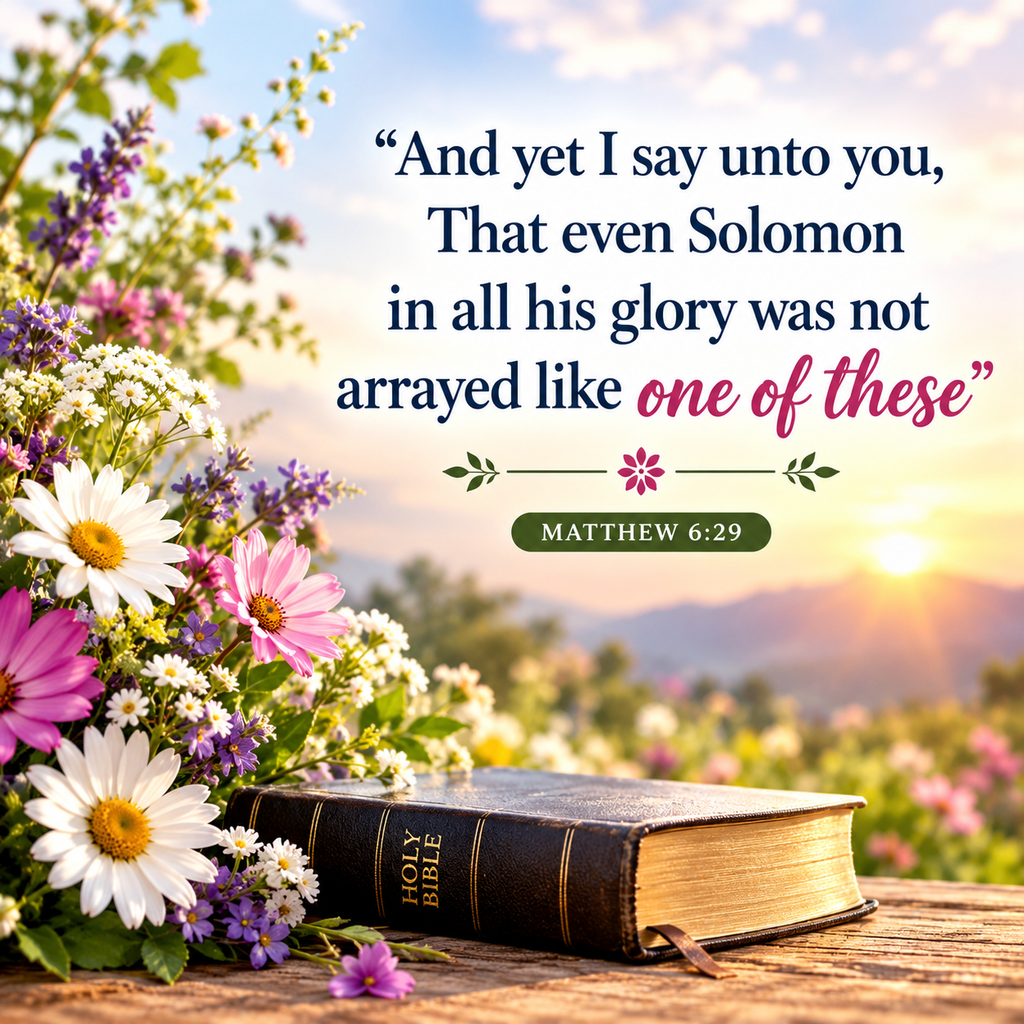
“And yet I say unto you, That even Solomon in all his glory was not arrayed like one of these.” (KJV)
What It Means
Solomon was Israel’s richest king and the son of David. His royal robes were famous far beyond his own land. Yet Jesus said a simple wild flower was dressed better.
How to Use It Today
Stop chasing fancy things to feel worthy. God’s gifts often arrive quietly, like a bloom beside a dusty road.
3. Matthew 6:30 – God Clothes the Grass, and You Can Trust His Care
“Wherefore, if God so clothe the grass of the field, which to day is, and to morrow is cast into the oven, shall he not much more clothe you, O ye of little faith?” (KJV)
What It Means
Imagine a poor family in Galilee burning dry grass in a clay oven. Jesus used that daily sight to call God their heavenly Father, the One who provides. Long before, Abraham named a mountain Jehovah-jireh, meaning “the LORD will provide.”
How to Use It Today
Write down one need and pray over it. Then take one small step and leave the rest with Him.
4. Luke 12:27 – Consider How the Wild Lilies Grow
“Consider the lilies how they grow: they toil not, they spin not; and yet I say unto you, that Solomon in all his glory was not arrayed like one of these.” (KJV)
What It Means
Luke was a doctor and a careful writer. His version of this teaching comes with a warning against greed. Jesus spoke it to followers who feared running short.
How to Use It Today
Take a slow walk this week. Watch one flower for a full minute without checking your phone.
Bible Verses About Flowers and the Shortness of Life
5. Isaiah 40:6 – All People Are Like the Flower of the Field
“The voice said, Cry. And he said, What shall I cry? All flesh is grass, and all the goodliness thereof is as the flower of the field:” (KJV)
What It Means
Isaiah was a prophet, a messenger who spoke for God. He wrote comfort for people living far from home as captives, a time called exile. “Goodliness” means beauty or strength, and it can fade like a blossom.
How to Use It Today
Hold your achievements lightly. Today is a gift, and none of us is promised tomorrow.
6. Isaiah 40:7 – The Breath of the LORD Makes the Flower Fade
“The grass withereth, the flower fadeth: because the spirit of the LORD bloweth upon it: surely the people is grass.” (KJV)
What It Means
Imagine a hot desert wind sweeping over a hillside. By evening, the flowers are dry. The Hebrew word ruach can mean wind, breath, or spirit, so the verse says God rules over every season.
How to Use It Today
Bring Him the season you are in right now, whether it feels like blooming or fading.
7. Isaiah 40:8 – The Word of Our God Stands Forever
“The grass withereth, the flower fadeth: but the word of our God shall stand for ever.” (KJV)
What It Means
After the sad picture comes hope. Everything on earth fades, but what God says stays. For weary captives, that meant He would keep His word.
How to Use It Today
Choose one promise from Scripture and memorize it this week. Lean on it when life shifts.
[link to related verse/topic on blessingsvault.com]
8. 1 Peter 1:24 – Human Glory Fades Like a Flower
“For all flesh is as grass, and all the glory of man as the flower of grass. The grass withereth, and the flower thereof falleth away:” (KJV)
What It Means
Peter was an apostle, one of Jesus’ close followers sent out to teach. He wrote to believers scattered across what is now Turkey, who faced pressure for their faith. He quoted Isaiah to say fame fades, so their hope needed firmer ground.
How to Use It Today
Notice where you look for praise from people. Shift one small act toward pleasing God instead.
9. James 1:11 – Wealth Fades Like a Flower in the Sun
“For the sun is no sooner risen with a burning heat, but it withereth the grass, and the flower thereof falleth, and the grace of the fashion of it perisheth: so also shall the rich man fade away in his ways.” (KJV)
What It Means
James led the early church in Jerusalem. He wrote to Jewish believers living far from home. He compared money to a flower scorched by the sun, using the Greek word anthos, which means a bloom.
How to Use It Today
Give a little away this week, since generosity loosens money’s grip on the heart. If money stress weighs on you, a trusted financial advisor can help alongside your faith.
10. Job 14:2 – Life Springs Up Like a Flower
“He cometh forth like a flower, and is cut down: he fleeth also as a shadow, and continueth not.” (KJV)
What It Means
Job lost his children and his health in one terrible season. In his pain, he felt how brief and fragile life is. His honest cry shows that God welcomes real feelings.
How to Use It Today
Tell God the truth in your own words today. Share it with a trusted friend or counselor too.
11. Psalm 103:15 – Our Days Are Like a Flower of the Field
“As for man, his days are as grass: as a flower of the field, so he flourisheth.” (KJV)
What It Means
King David wrote this psalm, a song of praise, to celebrate God’s kindness. He admitted that our days are short. Then he turned that truth into worship.
How to Use It Today
Count your blessings out loud, naming five from this week.
Bible Verses About Flowers, Hope, and Renewal
12. Isaiah 35:1 – The Desert Will Blossom Like the Rose
“The wilderness and the solitary place shall be glad for them; and the desert shall rejoice, and blossom as the rose.” (KJV)
What It Means
Here the prophet promised joy to God’s people after hard times. A dry desert would burst with color. The Hebrew word chavatselet, translated “rose,” may mean a crocus or another bulb flower.
How to Use It Today
Name one dry area in your life and ask God to bring life to it. Watch for small signs of change.
13. Isaiah 35:2 – The Desert Will Blossom Abundantly
“It shall blossom abundantly, and rejoice even with joy and singing: the glory of Lebanon shall be given unto it, the excellency of Carmel and Sharon, they shall see the glory of the LORD, and the excellency of our God.” (KJV)
What It Means
The picture grows bigger here. Lebanon, Carmel, and Sharon were among the greenest places in Israel. God promised that dry land would share their beauty, and people would see His glory in it.
How to Use It Today
Look for one place where God is already growing something good in you. Name it in your prayers.
14. Hosea 14:5 – Grow Like the Lily
“I will be as the dew unto Israel: he shall grow as the lily, and cast forth his roots as Lebanon.” (KJV)
What It Means
Hosea was a prophet who called Israel back to God after years of turning away. God answered with a tender promise. He would be like morning dew, and His people would grow like a lily, shoshannah in Hebrew.
How to Use It Today
Come back to God today, even after a failure. Ask Him to refresh you like morning dew.
15. Isaiah 27:6 – Israel Will Blossom and Bud
“He shall cause them that come of Jacob to take root: Israel shall blossom and bud, and fill the face of the world with fruit.” (KJV)
What It Means
Jacob, also called Israel, was the father of the twelve tribes. This verse looks ahead to a day when his family would thrive. Blossom and bud are pictures of fresh growth that leads to fruit.
How to Use It Today
Ask where God wants you to bear fruit. Serve one person this week in a simple way.
16. Isaiah 61:11 – Righteousness Springs Up Like a Garden
“For as the earth bringeth forth her bud, and as the garden causeth the things that are sown in it to spring forth; so the Lord GOD will cause righteousness and praise to spring forth before all the nations.” (KJV)
What It Means
This chapter brings good news to the broken. Jesus, the Messiah (God’s promised King), read from it in the synagogue at Nazareth, a Jewish place of worship. A gardener sows and waits, and God grows righteousness, or right living, with the same patience.
How to Use It Today
Plant one small seed of kindness today. Be patient while it grows.
[link to related verse/topic on blessingsvault.com]
Bible Verses About Flowers, Love, and Beauty
17. Song of Solomon 2:1 – The Rose of Sharon and the Lily of the Valleys
“I am the rose of Sharon, and the lily of the valleys.” (KJV)
What It Means
This love poem is linked to Solomon. Here the bride calls herself a simple wild flower of the Sharon plain, a green strip of land along the coast. Some Christians also hear Jesus in these words, but the poem itself is about human love.
How to Use It Today
Receive the beauty God placed in you. Then speak that same kindness over someone else.
18. Song of Solomon 2:2 – A Lily Among Thorns
“As the lily among thorns, so is my love among the daughters.” (KJV)
What It Means
Her beloved answers her next. He says she stands out like a lily among thorns. Love notices the beauty others miss.
How to Use It Today
Tell someone close what you treasure about them. A kind note or a small bouquet will do.
19. Song of Solomon 2:12 – The Flowers Appear in Spring
“The flowers appear on the earth; the time of the singing of birds is come, and the voice of the turtle is heard in our land;” (KJV)
What It Means
Winter in Israel brings cold rain, and then the hillsides turn green. The poet describes that moment, when flowers open and birds sing. The “turtle” here is a turtledove, not the animal.
How to Use It Today
Enjoy the next spring bloom you see. Let it lift your hope for a new season.
20. Song of Solomon 6:2 – Gathering Lilies in the Garden
“My beloved is gone down into his garden, to the beds of spices, to feed in the gardens, and to gather lilies.” (KJV)
What It Means
In this poem, the bride pictures her beloved walking through his garden to gather lilies. Gardens in the song stand for closeness and joy in married love. They also echo Eden, the first home God gave people.
How to Use It Today
Make time for the people you love. A shared walk through a garden counts.
Bible Verses About Flowers in Worship and God’s Miracles
21. Exodus 25:31 – Flowers on God’s Golden Lampstand
“And thou shalt make a candlestick of pure gold: of beaten work shall the candlestick be made: his shaft, and his branches, his bowls, his knops, and his flowers, shall be of the same.” (KJV)
What It Means
On Mount Sinai, God gave Moses plans for the tabernacle, the holy tent where Israel worshiped. One item was a golden lampstand covered in carved flowers. This shows that God loves beauty and wants it in worship.
How to Use It Today
Bring a little beauty to your place of prayer. One flower on the table can turn your thoughts toward Him.
22. Numbers 17:8 – Aaron’s Staff Bloomed Overnight
“And it came to pass, that on the morrow Moses went into the tabernacle of witness; and, behold, the rod of Aaron for the house of Levi was budded, and brought forth buds, and bloomed blossoms, and yielded almonds.” (KJV)
What It Means
Some Israelites doubted that Aaron should be a priest. God settled it by making a dry staff sprout overnight, with buds, blossoms, and ripe almonds. The Hebrew word for almond, shaqed, sounds like the word for “watching.”
How to Use It Today
Offer God an area of life that feels finished. He is able to do surprising things with what looks dry.
23. 1 Kings 6:18 – Open Flowers Carved in Solomon’s Temple
“And the cedar of the house within was carved with knops and open flowers: all was cedar; there was no stone seen.” (KJV)
What It Means
Solomon built the temple in Jerusalem, the grand house for worship. Its cedar walls were carved with open flowers and “knops,” small ornaments shaped like buds. Beauty was part of how Israel honored God.
How to Use It Today
Offer your best creative work to God. Make or fix something with care, and do it for His glory.
How to Pray About Flowers
To pray about flowers, pause and look closely at one bloom. Thank God for making it. Then tell Him one worry and ask Him to help you trust His care. End with a promise from Scripture. This takes about two minutes and works anywhere.
- Pause and look at the colors and shape.
- Say thank you out loud for something so lovely.
- Name one worry you carry today.
- Ask Him to help you trust His care.
- Close by repeating one promise from Scripture you know.
Here is a short prayer you can use:
“Father, thank You for the flowers You made. They remind me that You see me. Help me stop worrying and rest in Your love. Teach me to enjoy beauty and hold this life lightly. Let Your word be my steady ground. In Jesus’ name, amen.”
Fading Flowers vs. Flourishing Flowers: Bible Verses Compared
Fading flowers in the Bible teach us that life is short and we need humility. Flourishing flowers teach us that God brings hope and new growth. Both kinds of verses point to the same truth: only God and His word last forever.
| Category | Fading Flowers | Flourishing Flowers |
|---|---|---|
| Main message | Life is short and fragile | God brings growth and new life |
| Mood | Sober and humble | Hopeful and joyful |
| What it teaches | Do not trust fame or wealth | Trust God to renew you |
| Example verses | Job 14:2, Psalm 103:15 | Hosea 14:5, Isaiah 35:1 |
| What lasts | God’s word | God’s promises of fresh growth |
Frequently Asked Questions About Bible Verses About Flowers
What Flower Is Mentioned Most in the Bible?
The lily is one of the most named flowers in Scripture. It appears in Song of Solomon and Hosea, and Jesus pointed to “the lilies of the field.” Many scholars think that phrase covered several kinds of wild flowers.
What Is the Rose of Sharon in the Bible?
It is a flower named in Song of Solomon. Sharon was a fertile coastal plain in Israel. Scholars are not sure which plant it was, and some think it was a crocus or a similar bloom. Many Christians also connect the phrase to Jesus, though the poem itself is about human love.
What Do Flowers Symbolize in the Bible?
Flowers stand for beauty, God’s care, and the shortness of life. They also picture love, spring, and new beginnings. Their fading reminds us that only God’s word and mercy last forever.
What Did Jesus Mean by “Consider the Lilies”?
He told worried people to look closely at wild flowers. They do not work to dress themselves, yet God clothes them beautifully. He was inviting people to trust, not to stop working.
Did God Create Flowers?
Yes. The book of Genesis says that on the third day, God made plants and herbs that grow seed. Flowers are part of that good creation. Many Christians see them as small gifts from the Creator.
Which Bible Verse About Flowers Is Good for a Sympathy Card?
The Isaiah passages that contrast fading flowers with God’s lasting word are common choices. So is Jesus’ teaching about the lilies, which speaks of God’s tender care. If grief feels too heavy, a counselor or pastor can walk with you.
Conclusion
Bible verses about flowers teach two steady truths. Life is short, and God’s care is long. Jesus asked us to look at the lilies and set worry down. The prophets showed us deserts in bloom and people growing like lilies. These verses invite us to enjoy beauty, rest in His provision, and hold on to His word.

Hi, I’m James Walker , the creator of Blessings Vault. I write meaningful blessings, wishes, and inspirational messages to help people find the right words for every moment. My goal is to create content that is simple, heartfelt, and truly helpful for readers.